
Confession (religion)
Acknowledgment of sins across religious traditions for spiritual healing.

Alfred de Musset · Public domain
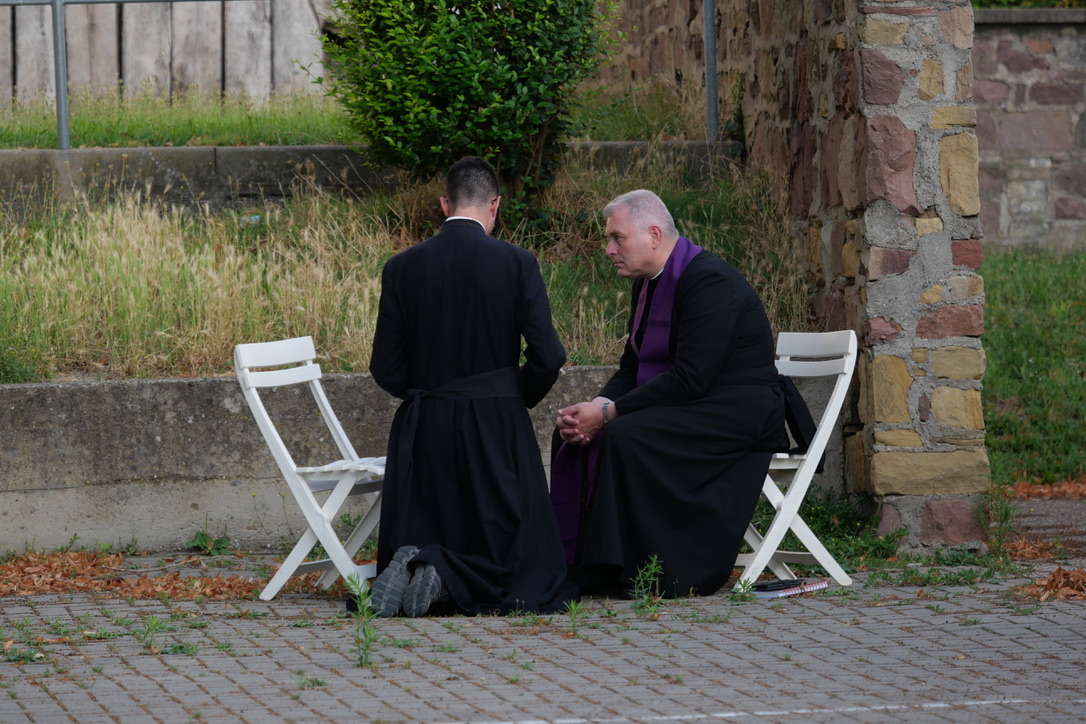
Confession, in many religions, is the acknowledgment of sinful thoughts and actions. It is performed privately to a deity or to a religious authority or congregation, and is often seen as a required action of repentance and a necessary precursor to penance and atonement. It frequently leads to reconciliation and forgiveness.
- field
- Religious practice
- known_for
- Acknowledgment of sins as a path to spiritual healing, restored relationships, and moral accountability across multiple traditions
Lore & Background
In Christianity, practices vary widely by denomination: Roman Catholics confess to a priest in a formal sacrament; Eastern Orthodox Christians confess to a spiritual father; Lutherans and Anglicans observe both private and corporate forms; while Reformed and Methodist traditions emphasize communal confession in worship. In Islam, sins are confessed directly to God through prayer, without any intermediary. Judaism incorporates communal confession on holy days such as Yom Kippur, as well as private confession to those one has wronged. In Hinduism, confession forms part of Prāyaścitta, a broader practice of penance and atonement. Confession also appears in secular contexts, such as the Twelve-Step Program of Alcoholics Anonymous. In Catholic Church teaching, the Sacrament of Penance is the method by which individuals confess any sins they have committed after their baptism; these sins are then absolved by God through the administration of a priest, who assigns an act of penance. To validly receive absolution, the penitent must make a sincere sacramental confession of all known mortal sins not yet confessed to a priest and pray an act of contrition. The Catholic Church teaches that sacramental confession requires three 'acts' on the part of the penitent: contrition, disclosure of the sins, and satisfaction.
Reader's Guide
Confession serves as a central practice in many religious traditions, providing a structured means for individuals to acknowledge wrongdoing, seek forgiveness, and restore relationships with the divine and community. Despite differences in form—whether private confession to a priest, direct prayer to God, or communal recitation—most traditions share a common understanding of confession as a path toward spiritual healing, restored relationships, and moral accountability. In Catholicism, the sacrament is obligatory at least once a year for serious sins and is conducted within a confessional box, booth, or reconciliation room. The priest acts in persona Christi and receives from the Church the power of jurisdiction over the penitent. The Seal of Confession protects against disclosure of anything learned during the sacrament. In Eastern Orthodoxy, confession is made to a spiritual father, often in the main part of the church before an analogion with a Gospel Book and blessing cross. The priest stands as a witness, and forgiveness is bestowed by Christ. The bond between an Orthodox Christian and their spiritual father is so deep that no legal official can override a spiritual guide in criminal cases. Confession's significance extends beyond Christianity, appearing in Islam, Judaism, Hinduism, and even secular contexts like Alcoholics Anonymous, underscoring its universal role in fostering accountability and spiritual renewal.
Did You Know?
- In Catholicism, the Seal of Confession protects against disclosure of anything learned during the Sacrament of Penance.
- In Eastern Orthodoxy, the bond between a Christian and their spiritual father is deeply respected, and clergy are bound by canon law and church teaching to maintain the confidentiality of confession, even in criminal cas
- The Catholic Church teaches that a perfect act of contrition removes the eternal punishment associated with mortal sin even outside of confession.
- Confession appears in secular contexts, such as the Twelve-Step Program of Alcoholics Anonymous.
From Paul's Writings to Councils: The Birth of Christian Creeds
The earliest identifiable creedal statement in Christian history traces back to the apostle Paul, whose letters contain the simple declaration 'Jesus is Lord.' Even earlier in character, scholars point to a passage in 1 Corinthians that preserves a brief formula about Jesus' death and resurrection, likely received by Paul from the Jerusalem apostolic community within roughly five years of the crucifixion. The formal, institutional era of creeds began in 325 at the First Council of Nicaea, where the Nicene Creed was crafted to affirm Christ's full deity and to push back against Arian teaching. A generation later, in 381, the First Council of Constantinople expanded the text to articulate the Trinity as a unified whole. The Chalcedonian Definition of 431 further sharpened the doctrine of Christ, and from that point forward, reciting or affirming this creed became, for many denominations, a baseline test of orthodoxy. The Apostles' Creed, drawing on second-century baptismal interrogations and the tripartite structure suggested by Matthew 28:19, became the shorter, more widely chanted companion in western liturgical life.
Naming the Belief: A Tangle of Terms
The vocabulary surrounding formal statements of faith is surprisingly layered. The English word 'creed' is a direct borrowing from the Latin credo, meaning 'I believe,' which served as the opening word of the Latin versions of both the Nicene and Apostles' Creeds. In a more specialized sense, a creed was also called a 'symbol,' a usage that entered Late Middle English from the Latin symbolum, itself borrowed from the Greek symbolon, originally meaning a token or watchword. In the broader Protestant tradition, longer written declarations are typically labeled 'confessions of faith' or simply 'confessions,' while Evangelical circles often prefer the phrasing 'doctrinal statement' or 'doctrinal basis.' These doctrinal statements can extend to practical matters such as lectionary choices and preferred Bible translations, a concern particularly visible in King James Only fundamentalist congregations. Beyond Christianity, the concept finds a parallel in Islamic theology through the term ʿaqīdah, literally 'bond' or 'tie,' which English-language writers frequently translate as 'creed' to draw a cross-faith comparison.
Saying No to Creeds: The Non-Creedal Tradition
Not every Christian community embraces a formal creed. The Anabaptist movement, born out of the sixteenth-century Radical Reformation, explicitly rejected creeds in favor of the Bible alone, a stance that made them targets of persecution from both Catholic and Protestant authorities. Descendant groups such as the Amish, Hutterites, Mennonites, Schwarzenau Brethren, River Brethren, Bruderhof, and the Apostolic Christian Church continue this 'no creed but the Bible' posture. The Quakers, founded in the seventeenth century, share a similar wariness, arguing that written words, steeple-houses, and clerical hierarchies cannot substitute for lived communal relationship with God. The Restoration Movement and its heirs—the Christian Church (Disciples of Christ), the Churches of Christ, and related bodies—profess 'no creed but Christ.' The Seventh-day Adventist Church holds comparable reservations. Jehovah's Witnesses draw a sharp line between memorizing creeds and simply doing what Jesus commanded. Within the Latter Day Saint movement, mainstream creeds are set aside, though Joseph Smith's 1842 Articles of Faith, written in a letter to Chicago Democrat editor John Wentworth, serve as a canonical statement alongside the standard works.
Guardrails and Grace: How Creeds Function in Practice
Creeds serve a dual purpose: they define shared identity while also drawing boundaries. Historically, affirmation of the Nicene Creed functioned as a fundamental test of orthodoxy, and most denominations retain the practice of excommunication to exclude members who refuse to respect the community's confession of faith and decline to repent, thereby protecting the body from the spread of heretical teaching and apostasy. Yet the tradition is not uniformly rigid. Many denominations deliberately avoid exhaustive confessions, leaving room for divergent opinions on secondary matters, and some remain open to revising their statements when circumstances demand it. The 1646 Revised First London Baptist Confession captures this humility with a clause acknowledging that its authors 'know but in part' and are 'ignorant of many things,' pledging gratitude to anyone who, from the Word of God, reveals what they have missed. In the Protestant world, confessions of faith also act as a practical basis for fellowship, allowing churches of the same denomination to recognize one another without requiring total doctrinal uniformity on every point.
Gallery


Frequently Asked Questions
What is Confession (religion)?
In Christian theology, confession is the deliberate act of admitting one's sinful thoughts and deeds before God or a clergy member. It functions as the foundational first step in the broader process of turning back toward God.
What is Confession (religion)'s role in Christian practice?
It serves as the required opening move in the sequence of repentance, penance, and atonement. Without this honest acknowledgment, the subsequent steps of making amends and receiving forgiveness are considered incomplete.
How is Confession (religion) typically carried out?
A believer may speak privately to God in personal prayer or address a priest, pastor, or gathered congregation. The act centers on naming specific sins honestly rather than offering vague generalities.
Why is Confession (religion) important to believers?
It creates a pathway toward spiritual healing, mended relationships with God and the community, and a renewed sense of moral accountability. Many traditions view it as the essential bridge between guilt and genuine reconciliation.
What is the expected outcome of Confession (religion)?
The theological goal is forgiveness, restored fellowship, and the granting of grace that enables the believer to move forward. It is understood not as a one-time event but as an ongoing rhythm of self-examination and return.
More in Christian Theology 25-36
Elsewhere in the Christian Theology universe
Spotted an error? Know more?
This is a living reference — every entry is fact-audited, and reader corrections feed straight into our audit queue. Suggest an edit · See this site's audit record