
Christian symbolism
Symbols conveying Christian ideas through objects, actions, and artwork.

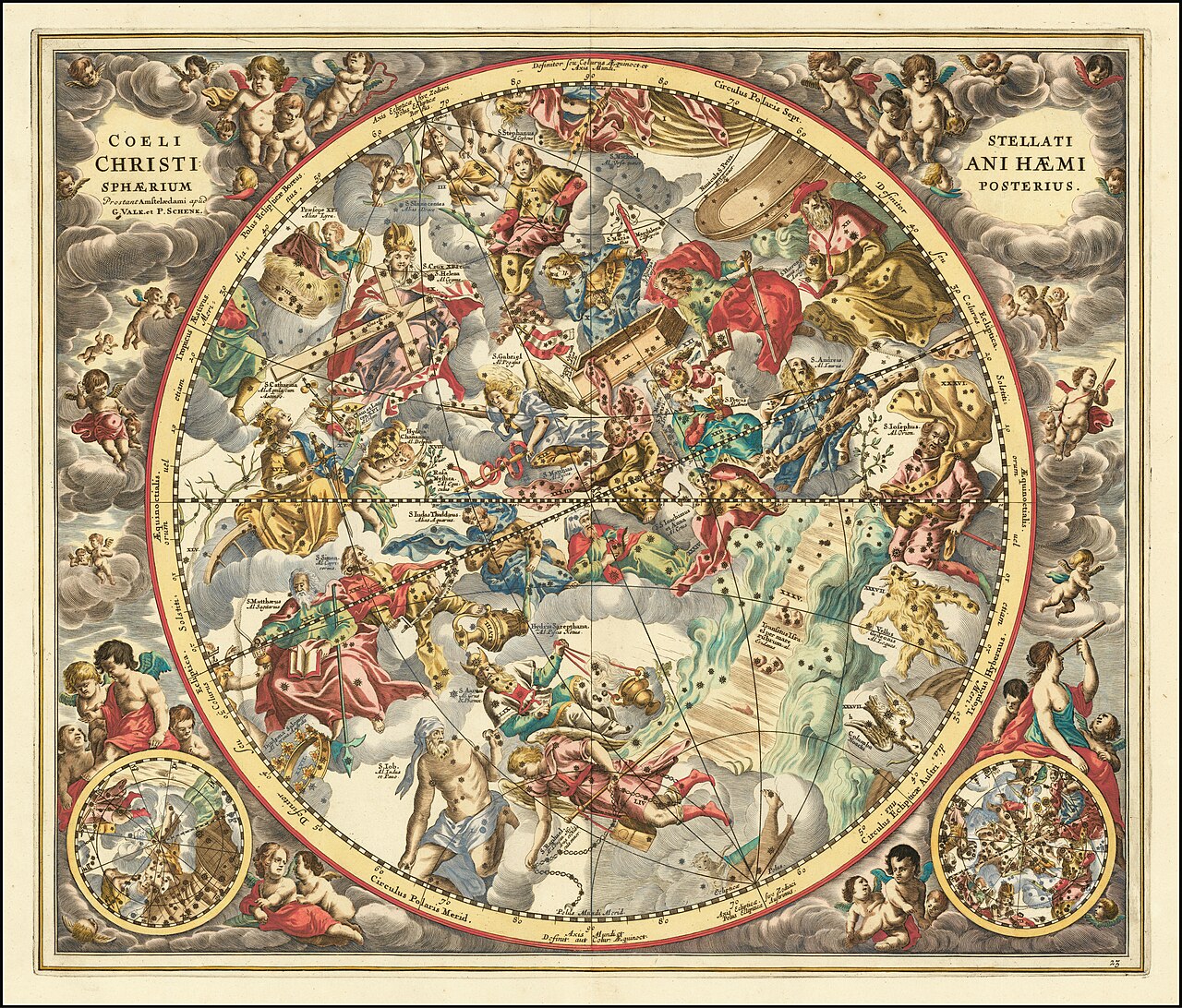
Andreas Cellarius · Public domain
Christian symbolism is the use of symbols, including archetypes, acts, artwork or events, by Christianity. It invests objects or actions with an inner meaning expressing Christian ideas. The symbolism of the early Church was characterized by being understood by initiates only, while after the legalization of Christianity in the Roman Empire during the 4th century more recognizable symbols entered in use. Christianity has borrowed from the common stock of significant symbols known to most periods and to all regions of the world.
- field
- Christian theology and art
- known_for
- Use of symbols such as the cross, ichthys, Chi Rho, and alpha and omega to express Christian ideas
- period
- 2nd century onward
Lore & Background
Early Christian symbols were often understood only by initiates. The cross, represented by the letter T, was used as a seal by the 2nd century. The ichthys (fish) ranked first in importance among early symbols, based on a Greek acrostic meaning 'Jesus Christ, God's Son, Saviour.' The alpha and omega, first and last letters of the Greek alphabet, derive from statements in Revelation. The staurogram, composed of tau and rho, was used to abbreviate the Greek word for cross in early New Testament manuscripts and may have visually represented Jesus on the cross. The Chi Rho monogram, formed from the first two letters of 'Christ' in Greek, was used by Emperor Constantine I as a vexillum. The IH monogram, using the first two letters of Jesus' name in Greek, was an early way to represent Christ.
Reader's Guide
Christian symbolism matters because it provided a visual and conceptual language for expressing core beliefs, especially during periods of persecution when symbols were understood only by initiates. After the 4th-century legalization of Christianity, more recognizable symbols entered use. The cross, ichthys, Chi Rho, and alpha and omega became enduring identifiers of the faith. The use of symbols also reflects Christianity's borrowing from the common stock of significant symbols known to most periods and regions. Only a minority of denominations, such as early Jewish Christian sects and some modern Baptists, have practiced aniconism due to the Decalogue's prohibition of idolatry. The development of symbols like the crucifix and the Good Shepherd image shows how artistic conventions evolved over centuries, with the crucifix becoming common only after the 5th century. The dove as a symbol of the Holy Spirit appears frequently in early baptismal art. These symbols continue to be used in Christian worship, art, and identity worldwide.
Did You Know?
- The shape of the cross, as represented by the letter T, came to be used as a 'seal' or symbol of Early Christianity by the 2nd century.
- The ichthys (fish) symbol is based on a Greek acrostic: 'Ἰησοῦς Χριστὸς Θεοῦ Υἱὸς Σωτήρ' (Jesus Christ, God's Son, Saviour).
- The staurogram, composed of tau and rho, was used to abbreviate the Greek word for cross in very early New Testament manuscripts such as P66, P45, and P75.
- The Chi Rho monogram was used by the Roman emperor Constantine I as a vexillum (named Labarum).
From Secret Sign to Public Emblem
The early Church kept its symbolic language largely hidden, reserving deeper meaning for those who had been initiated into the faith. This changed dramatically once Christianity was legalized within the Roman Empire in the fourth century, at which point symbols that were once restricted to insiders became broadly recognizable to the general public. The faith drew upon a shared reservoir of meaningful imagery that had existed across many cultures and eras, weaving those pre-existing visual traditions into its own theological vocabulary. Even before legalization, the cross shape—rendered simply as the letter T—served as a private seal of Christian identity by the second century. Tertullian, writing in 204, recorded that believers already traced this mark on their foreheads as a personal devotion. The transition from covert gesture to public monument was not instantaneous; it unfolded over centuries as the Church moved from catacombs to basilicas, and symbols that once whispered a secret became declarations visible to all.
The Cross Takes Shape
The visual form of the cross in Christian art evolved over many centuries. In the earliest centuries, the cross was rendered as a simple T-shape, a form Clement of Alexandria in the early third century called the Lord's sign. He also connected the number 318 in Genesis to a foreshadowing of the cross and of Jesus, reading the Greek numerals as a hidden message. It was not until the late period of Late Antiquity that the familiar Greek and Latin crosses with intersecting beams began appearing in Christian artwork. An early example of a cruciform halo identifying Christ appears in a mosaic at Sant'Apollinare Nuovo in Ravenna, dated around 504. Regional variations followed: the St Thomas cross with clover-leaf edges emerged in southern India by roughly the sixth century, while the Patriarchal cross with its extra horizontal bar did not appear until the tenth century. The Celtic cross, with its distinctive ring around the intersection of arms, is tied to early medieval art in Ireland and Britain. Crucifix depictions showing the suffering body of Christ were rare before the fifth century, and the first examples displaying a slumped, agonized form are generally traced to Byzantine artistic development.
Letters as Theology
Before elaborate imagery became common, early Christians encoded profound theological statements in single letters and acrostics. The fish symbol, known as the Ichthys, ranked first among their emblems. Its power lay in an acrostic: the initial letters of five Greek words—Jesus, Christ, God's Son, Saviour—spelled out the word for fish itself. Augustine of Hippo cited this explanation in his work on the City of God. Similarly, the first and last letters of the Greek alphabet, alpha and omega, carried the weight of a declaration attributed to Jesus or God in the Book of Revelation, identifying the speaker as the First and the Last, the Beginning and the End. The Staurogram, a tau superimposed on a rho, first appeared as an abbreviation for the Greek word for cross in very early New Testament manuscripts. Ephrem the Syrian in the fourth century interpreted the tau as the cross and the rho as connected to the idea of help, so that the combined mark expressed the concept that the Cross saves. These letter-based symbols spread across Western Europe in the fifth and sixth centuries, carrying compact theological meaning in a single visual gesture.
The Question of Images
Not all Christian communities embraced visual symbolism. A minority of denominations have historically practiced aniconism, the deliberate avoidance or outright prohibition of certain types of images. This stance traces back to early Jewish Christian sects and continues in some modern groups, including certain Baptist traditions, which prefer to limit the use of figurative elements in their symbols. Their reasoning draws on the Decalogue's prohibition against idolatry, a concern that Tertullian himself addressed in the early third century when he pushed back against pagan accusations that Christians were worshippers of the gibbet. He turned the charge around, comparing the veneration of pagan idols to the worship of mere poles or stakes. This tension between symbolic expression and the fear of idolatry has shaped Christian visual culture for two millennia, creating a spectrum from the richly iconographic traditions of Byzantine and Romanesque art to the austere, text-focused worship spaces of aniconic communities.
Gallery
Frequently Asked Questions
What is Christian symbolism in simple terms?
Christian symbolism is the practice of giving objects, actions, artworks, or events a deeper spiritual meaning that communicates theological ideas. It functions as a visual and experiential language for expressing faith concepts beyond plain words.
What are the most well-known symbols in Christian symbolism?
The cross, the ichthys (fish), the Chi Rho monogram, and the letters alpha and omega are among the most recognizable symbols used to convey Christian ideas. These have been central to the tradition from the 2nd century onward.
How did early Christian symbolism differ from later usage?
In the early Church, symbols were largely understood only by those who had been initiated into the faith, keeping their meaning somewhat hidden. After Christianity was legalized in the Roman Empire in the 4th century, more publicly recognizable symbols became common in everyday use.
What field of study does Christian symbolism fall under?
Christian symbolism sits at the intersection of Christian theology and art. It draws from a shared pool of significant symbols that have appeared across many cultures, periods, and regions throughout human history.
Why is Christian symbolism considered important in theology?
It allows believers to invest ordinary objects and actions with deeper spiritual meaning, making abstract Christian ideas tangible and accessible. This symbolic layer has been a core part of how the faith communicates from the 2nd century to the present.
More in Christian Theology 25-36
Elsewhere in the Christian Theology universe
Spotted an error? Know more?
This is a living reference — every entry is fact-audited, and reader corrections feed straight into our audit queue. Suggest an edit · See this site's audit record